

It’s a structured, evidence-based rehabilitation approach that addresses pain, stiffness, and weakness in the elbow joint through manual therapy, targeted exercise, and activity modification, aiming to restore full, pain-free function.

Elbow Injury Physiotherapy Management in Etobicoke


Elbow Injury Physiotherapy Management in Etobicoke
Elbow injury physiotherapy management in Etobicoke to relieve pain, restore strength, and support recovery from tendon, joint, and overuse injuries.
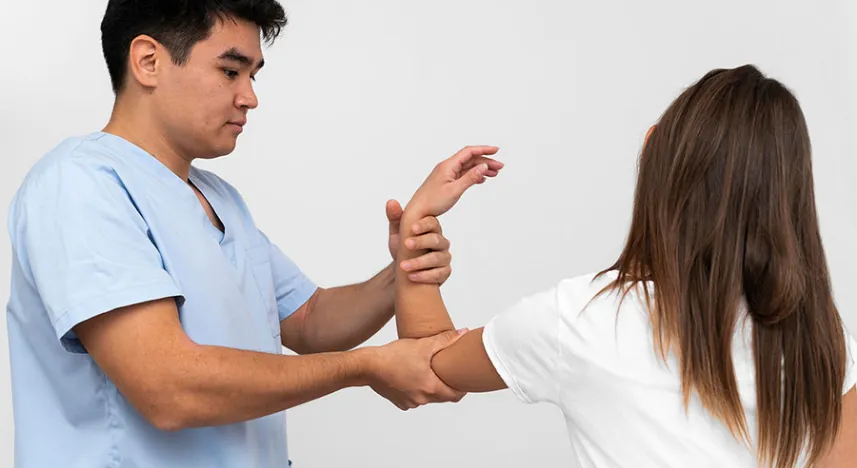
Elbow Injury Physiotherapy in Etobicoke
Relieve Pain. Rebuild Strength. Move Freely Again.
If everyday tasks like turning a doorknob, lifting a coffee cup, typing, or shaking someone’s hand have started to hurt, you’re not alone. Elbow pain is one of the most common — and most misunderstood — musculoskeletal complaints we see at Rapharehab, a trusted physiotherapy and rehab clinic in Etobicoke. Whether it’s a sharp twinge from sports, a dull ache from a desk job, or ongoing stiffness after an injury or surgery, our elbow physiotherapy Etobicoke residents rely on is designed to find the real cause of your pain — not just mask the symptoms.
This page walks you through everything you need to know: what’s causing your elbow pain, the conditions we treat, how our physiotherapists diagnose and manage elbow injuries, what your recovery timeline might look like, and how to prevent the problem from coming back. If you’d rather skip ahead, jump straight to booking an assessment — but if you want to understand your elbow pain first, keep reading.
Understanding Elbow Pain: Why It Happens
The elbow is a hinge joint that connects the humerus (upper arm bone) to the radius and ulna (forearm bones). It relies on a network of tendons, ligaments, muscles, and nerves to allow bending, straightening, gripping, and rotating movements. Because the forearm muscles that control your wrist and fingers attach directly at the elbow, almost any repetitive hand or wrist activity — typing, lifting, gripping tools, swinging a racquet — places load through this joint.
Most elbow injuries fall into one of three categories:
- Overuse and repetitive strain injuries — gradual tendon irritation from repeated gripping, lifting, or wrist movement (the most common cause by far)
- Traumatic injuries — falls, direct blows, sudden overstretching, or sports collisions causing sprains, strains, or fractures
- Post-surgical or degenerative issues — stiffness and weakness following elbow surgery, arthritis, or long-term joint wear
Understanding which category your pain falls into is the first step toward effective elbow injury physiotherapy management — and it’s exactly what a proper assessment at Rapharehab is designed to uncover.
Common Signs You Need Elbow Physiotherapy
You don’t need to wait until the pain becomes unbearable. Consider booking an assessment if you’re experiencing:
- Aching or sharp pain on the outer or inner elbow that worsens with gripping or lifting
- Weak grip strength or trouble holding everyday objects like a mug or steering wheel
- Stiffness, especially first thing in the morning or after periods of rest
- Pain that radiates down into the forearm or wrist
- Swelling, tenderness, or warmth around the joint
- Numbness or tingling into the ring and little fingers
- Reduced range of motion when straightening or bending the arm
- Pain that has persisted for more than two to three weeks despite rest
Left untreated, minor elbow strain can progress into chronic tendinopathy, reduced function, and compensatory pain in the shoulder, wrist, or neck. Early physiotherapy intervention consistently produces faster, more complete recovery than a “wait and see” approach.
Conditions We Treat: Elbow Injury Physiotherapy Management in Etobicoke
Our physiotherapists manage the full spectrum of elbow conditions, using evidence-based protocols tailored to your diagnosis, activity level, and goals.
Tennis Elbow (Lateral Epicondylitis)
The most common elbow overuse injury, tennis elbow causes pain on the outside of the elbow where the wrist-extensor tendons attach. Despite the name, most people who develop it have never picked up a racquet — it’s just as common among office workers, tradespeople, and anyone who repeatedly grips, types, or lifts. Physiotherapy for tennis elbow pain relief in Etobicoke typically combines manual therapy, eccentric loading exercises, and activity modification for lasting results.
Golfer’s Elbow (Medial Epicondylitis)
The mirror-image condition, golfer’s elbow affects the tendons on the inside of the elbow that control wrist flexion. It’s common in golfers, weightlifters, and manual laborers who perform repetitive gripping or throwing motions.
Elbow Sprains and Strains
Sudden overstretching of the ligaments (sprain) or muscles/tendons (strain) — often from a fall, awkward lift, or sports collision — causing pain, swelling, and reduced movement.
Elbow Tendonitis and Tendinopathy
Chronic overuse leads to microscopic tendon damage. Left untreated, tendonitis can progress to tendinosis, a more stubborn, degenerative condition requiring structured, progressive rehabilitation.
Ligament Injuries
Including ulnar collateral ligament (UCL) strain, common in throwing athletes, which affects the inner elbow’s stability during forceful arm motion.
Ulnar Nerve Irritation (Cubital Tunnel-Type Symptoms)
Compression or irritation of the ulnar nerve as it passes through the elbow can cause numbness, tingling, or weakness into the ring and pinky fingers — often mistaken for a purely muscular issue.
Elbow Stiffness and Limited Range of Motion
Whether from immobilization, injury, or arthritis, a stiff elbow limits reaching, lifting, and dressing tasks. Targeted mobility work helps restore full function.
Postural and Repetitive Strain Injuries
Prolonged desk work, poor workstation ergonomics, and sustained gripping (mouse, keyboard, tools) gradually overload the elbow tendons even without a single injury event.
Work-Related and Sports-Related Elbow Injuries
From tradespeople using power tools to athletes in racquet sports, throwing sports, and weightlifting, activity-specific elbow injuries need activity-specific rehab — not a generic protocol.
Post-Surgical Elbow Rehabilitation
Following fracture fixation, ligament repair, or joint replacement, structured post-surgical elbow rehabilitation in Etobicoke restores strength and motion safely, in coordination with your surgeon’s protocol.
How We Diagnose Your Elbow Injury
Effective elbow injury physiotherapy management starts with an accurate diagnosis, not guesswork. During your initial assessment at Rapharehab, your physiotherapist will:
- Take a detailed history — how and when your pain started, what makes it better or worse, your work and activity demands
- Perform a physical examination — assessing range of motion, grip and forearm strength, and joint stability
- Use special orthopedic tests — such as resisted wrist extension/flexion tests to differentiate tennis elbow, golfer’s elbow, nerve irritation, or referred pain from the neck and shoulder
- Screen surrounding joints — because elbow pain is often driven by shoulder weakness, neck stiffness, or wrist mechanics, not the elbow alone
- Build a personalized treatment plan — based on your specific diagnosis, goals, and timeline for return to work or sport
This whole-body approach is why patients who’ve tried rest, braces, or generic exercises elsewhere often find lasting relief once the true root cause is identified.
Elbow Injury Physiotherapy Techniques We Use
Your customized elbow rehabilitation program at Rapharehab may include a combination of:
- Manual Therapy & Joint Mobilization — hands-on techniques that relieve stiffness and restore smooth, pain-free joint movement
- Soft Tissue Release — targeting tight, overloaded, or irritated forearm muscles contributing to your pain
- Tendon-Specific Rehabilitation — structured loading protocols for the extensor tendons (tennis elbow) or flexor tendons (golfer’s elbow)
- Eccentric Strengthening Exercises — a clinically proven strategy for tendon healing, using controlled, slow-lengthening loads to rebuild tendon resilience
- Grip and Forearm Strength Training — progressive strengthening to restore functional lifting and gripping capacity
- Stretching and Mobility Exercises — restoring full, comfortable range of motion at the elbow, wrist, and shoulder
- Ergonomic and Activity Modification Guidance — practical adjustments to your desk setup, tools, grip size, or sports technique to reduce ongoing strain
- Laser Therapy and Electrotherapy Modalities — supporting tissue healing and pain reduction where clinically appropriate
- Bracing and Taping Strategies — offloading strain from the tendon during the early, most irritable phase of recovery
Every program is progressed gradually — because with tendon injuries in particular, doing too much too soon is one of the most common reasons recovery stalls or pain returns.
What to Expect: Your Elbow Recovery Timeline
Recovery timelines vary based on the severity, duration, and type of your elbow injury, but a general phase-based approach looks like this:
Phase 1 — Calm It Down (Week 1–2): Reduce pain and inflammation through manual therapy, activity modification, and gentle range-of-motion work.
Phase 2 — Rebuild Capacity (Week 2–6): Progressive strengthening, tendon loading, and grip work to restore tissue tolerance.
Phase 3 — Return to Function (Week 6–12+): Sport- or work-specific training, technique correction, and a structured return-to-activity plan to reduce the risk of recurrence.
Many patients notice meaningful pain reduction within the first few sessions, though tendon conditions like tennis and golfer’s elbow are notorious for lingering if rehab is stopped too early. A structured, complete program significantly lowers your chance of recurrence.
Benefits of Elbow Injury Physiotherapy at Rapharehab
- Reduced elbow pain and inflammation
- Improved flexibility and joint mobility
- Stronger forearm, wrist, and elbow-supporting muscles
- Faster, safer tendon recovery through evidence-based loading
- Improved grip strength and functional movement
- Lower risk of reinjury or chronic recurrence
- Personalized, ongoing guidance as your recovery progresses
- Better performance at work, in sport, and in daily life
Preventing Elbow Pain From Coming Back
Because so many elbow injuries stem from repetitive strain, prevention is just as important as treatment. Our physiotherapists commonly recommend:
- Adjusting workstation ergonomics — chair height, keyboard/mouse position, and forearm support
- Using proper grip size on tools, racquets, or gym equipment
- Building a regular forearm and grip-strengthening routine, even after symptoms resolve
- Taking micro-breaks during repetitive tasks to avoid sustained tendon loading
- Warming up before sports and gradually increasing training load
- Addressing shoulder and neck mobility, since weakness upstream often overloads the elbow
Why Choose Rapharehab for Elbow Physiotherapy in Etobicoke?
- Treatment from experienced physiotherapists who specialize in elbow and upper-limb rehabilitation
- Thorough, whole-body assessment to identify the true root cause of your pain — not just the symptom
- Customized treatment plans built around your work, sport, and daily activities
- Integration of manual therapy, strengthening, and modalities like laser therapy and electrotherapy for comprehensive care
- Clear guidance on posture, ergonomics, and injury prevention so results last
- Supportive, patient-focused care in a modern Etobicoke clinic
- Flexible scheduling and direct billing options to make care convenient
- Conveniently located at 5–4335 Bloor Street West, Etobicoke, M9C 2A5
Start Your Elbow Recovery Today
If elbow pain, stiffness, or weak grip is affecting your work, sport, or daily life, you don’t have to just push through it. Our elbow injury physiotherapy management in Etobicoke is built to identify exactly what’s driving your pain and create a clear, personalized path back to strength and function.
Book your elbow assessment at Rapharehab today and discover why patients across Etobicoke trust us for effective, lasting elbow pain relief.
 Call 647-722-3434 |
  5–4335 Bloor Street West, Etobicoke, M9C 2A5
Frequently Asked Questions
-
What is elbow injury physiotherapy management?
-
What are the most common causes of elbow pain?
Repetitive gripping or lifting, poor workstation ergonomics, sports like tennis and golf, sudden falls or trauma, and post-surgical stiffness are the most frequent causes we see in Etobicoke.
-
What’s the difference between tennis elbow and golfer’s elbow?
Tennis elbow (lateral epicondylitis) causes pain on the outside of the elbow, while golfer’s elbow (medial epicondylitis) causes pain on the inside. Both are overuse tendon injuries but affect opposite muscle groups.
-
Do I need a doctor’s referral to see a physiotherapist for elbow pain?
In Ontario, you can typically book directly with a physiotherapist without a physician referral, though your insurance provider may have specific requirements — we can help you check.
-
How long does it take to recover from tennis elbow with physiotherapy?
Many patients notice reduced pain within two to three weeks of starting treatment, but full tendon recovery generally takes six to twelve weeks, depending on severity and how consistently the rehab program is followed.
-
Can elbow pain go away on its own without treatment?
Mild strain sometimes settles with rest, but tendon-related conditions like tennis and golfer’s elbow are notoriously persistent and often worsen without proper loading and rehabilitation.
-
Is it safe to keep working or exercising with elbow pain?
It depends on the severity. In many cases, modified activity is safe and even beneficial, but continuing painful movements without guidance can delay healing — an assessment will clarify what’s safe for you.
-
What does an elbow physiotherapy assessment involve?
Your physiotherapist will review your history, test your strength and range of motion, perform special orthopedic tests, and screen your neck, shoulder, and wrist, since elbow pain is often linked to these areas.
-
What treatments are used for tennis elbow?
Common treatments include manual therapy, eccentric strengthening exercises, soft tissue release, activity modification, bracing, and modalities like laser therapy or electrotherapy.
-
Can physiotherapy help golfer’s elbow?
Yes. Golfer’s elbow responds well to the same evidence-based approach as tennis elbow — targeted tendon loading, manual therapy, and gradual strengthening of the flexor muscle group.
-
What is eccentric strengthening and why is it used for elbow tendon injuries?
Eccentric strengthening involves slow, controlled lengthening of a muscle under load. It’s one of the most clinically supported methods for rebuilding tendon strength and resilience in conditions like tennis and golfer’s elbow.
-
Can a stiff elbow after surgery be improved with physiotherapy?
Yes. Post-surgical elbow rehabilitation focuses on gradually restoring range of motion and strength while respecting your surgeon’s healing protocol and timelines.
-
Why does my elbow pain cause tingling in my fingers?
This can indicate ulnar nerve irritation as it passes through the elbow. A physiotherapy assessment can determine whether nerve involvement is contributing to your symptoms.
-
Can poor posture at a desk cause elbow pain?
Yes. Sustained wrist extension while typing, unsupported forearms, and prolonged static postures place ongoing strain on the elbow tendons, often leading to overuse injuries over time.
-
Should I use a brace or elbow strap for tennis elbow?
A brace can help offload strain from the tendon during daily activities, especially in the early stages, but it works best alongside — not instead of — a structured strengthening program.
-
Is ice or heat better for elbow pain?
Ice is generally recommended in the first few days after a flare-up to limit inflammation. Heat may help with longer-standing stiffness by increasing circulation. Your physiotherapist can advise what’s best for your specific stage of healing.
-
Can elbow injuries lead to shoulder or wrist problems if untreated?
Yes. Compensating for elbow pain often shifts strain to the shoulder, wrist, or neck, creating secondary issues if the original injury isn’t properly addressed.
-
How many physiotherapy sessions will I need for elbow pain?
This varies by condition and severity, but many patients begin a structured plan with sessions once or twice a week initially, tapering as strength and function improve. Your physiotherapist will outline a specific plan after your assessment.
-
Can athletes return to sport after elbow physiotherapy?
Yes. Our programs include sport-specific strengthening and a gradual return-to-play plan designed to rebuild capacity safely and reduce the risk of recurrence.
-
What should I do if my elbow pain keeps coming back?
Recurring elbow pain usually means the underlying cause — whether it’s grip mechanics, workstation setup, or incomplete rehab — hasn’t been fully addressed. A thorough reassessment can identify what’s been missed.
-
Does insurance cover elbow physiotherapy in Etobicoke?
Many extended health plans cover physiotherapy services. Rapharehab offers direct billing to a range of insurance providers — contact our clinic to confirm your specific coverage.
-
How do I book an elbow physiotherapy appointment at Rapharehab?
You can call us at 647-722-3434 or visit our Etobicoke clinic at 5–4335 Bloor Street West to schedule your initial assessment.