


Car Accident Recovery: How Long Does It Take?

Car Accident Recovery: How Long Does It Take?
A car accident can cause a wide range of injuries – from minor muscle soreness to multi-system traumas involving joints, ligaments, nerves, spine, or brain. It is not uncommon for people dealing with insurance companies or physiotherapy clinics in Etobicoke to ask – how long will it take before I recover?
Unfortunately,
there is no simple answer – the healing timeline depends on the injury severity, the range of tissues involved, overall health, age, activity level, additional conditions, and how quickly you start the recovery process.
Most minor tissue injuries caused by a car accident start feeling better in a few weeks, but more serious ones – such as severe whiplash, ligament damage, or concussion – take several months to heal. And some injuries have long-lasting effects, making regular physiotherapy sessions necessary.
People in Etobicoke and elsewhere in Toronto searching for physiotherapy toronto often seek medical assistance not only to relieve pain but also to restore range of motion, flexibility, balance, coordination, strength, and function.
The Healing Timeline After a Car Accident
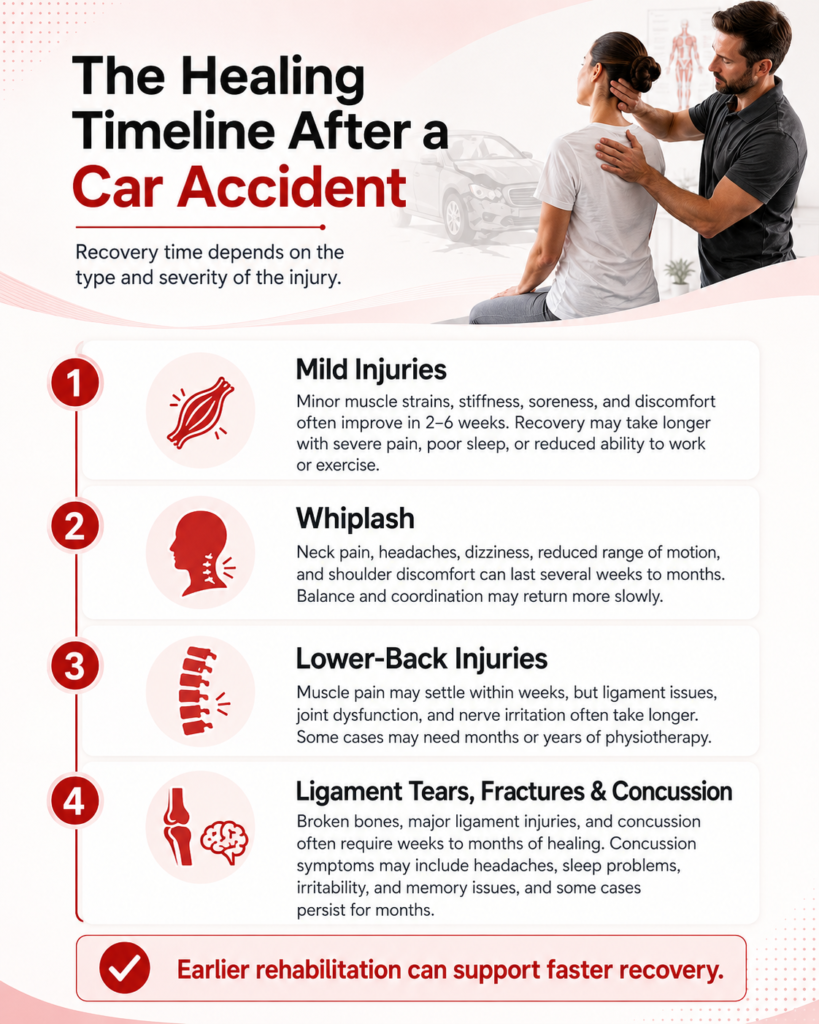
Mild car accident injuries
may only last for a couple of weeks.
The most common ones are minor muscle strains – stiffness, soreness, discomfort, or pain in the muscles of the shoulders, neck, lower back, or other parts of the body. They usually resolve within 2-6 weeks – but if you have severe restrictions, pain, poor sleep, or reduced ability to work or exercise, the healing process may take longer.
More serious injuries such as whiplash
often involve the neck and can last for several weeks or months. In addition to muscle pain and stiffness, you may experience headaches, dizziness, reduced range of motion, and discomfort in the shoulders. Some symptoms of whiplash, such as poor coordination and balance, are often slow to return. See our detailed overview of whiplash for more information.
Lower-back injuries
can also be short- or long-term, depending on the tissues affected. Muscular pain often resolves within a few weeks, but ligament issues, joint dysfunction, and nerve irritation take longer to heal. Similarly, multiple injuries or post-traumatic osteoarthritis may require months or years of physiotherapy. Many people in Etobicoke and Toronto ask our physiotherapy near me experts about lower back pain treatment after a car accident.
Injuries such as ligament tears, fractures, or concussion
often require a prolonged healing period. Depending on the severity, broken bones or severely damaged ligaments can take weeks or months to heal. Concussion is a complex injury with a broad range of physical and cognitive symptoms, including sleep disturbances, headaches, irritability, memory problems, and more. Some of them resolve quickly, but others – such as post-concussion syndrome – can last for months. For each of these conditions, the earlier you start your rehabilitation, the faster you will see results.
What Determines How Long It Takes to Heal From an Accident?
Various factors influence the rate of the healing process after a car accident.
The severity and nature of the injury
The more serious the injury is, the longer it will take to heal. It is impossible to predict the full extent of the damage immediately after an accident, and some injuries such as ligament tears or fractures have long recovery periods. A minor strain, on the other hand, rarely takes more than a couple of months to heal.
Two people involved in a similar accident can have considerably different injuries because of the differences in body structure and how they positioned their body during the crash.
The tissues affected also matter – for example, an injury involving the joints and ligaments will likely take longer to heal than a muscle strain.
The number of sites injured also impacts the recovery time.
If you have multiple injuries, such as neck pain, lower-back pain, headache, and dizziness, it means that more tissues were affected. This will prolong the healing period and dictate the rehabilitation program since it must be designed to address multiple areas of concern rather than focus on one region.
Previous injuries
are yet another factor that determines how long it takes to heal from an accident. For example, if you had a serious lower-back injury before the crash, it will take you longer to return to normal activities after another lower-back injury. Similarly, poor coordination or prolonged muscle spasms as a result of the past trauma will slow down the rehabilitation process. This does not mean that those conditions cannot be resolved – they only need more time and special treatment.
Age
may also be a limiting factor – most older people find that it takes them longer to recover from an injury as compared to when they were younger. This is especially common for people with chronic conditions such as arthritis, osteoporosis, diabetes, or heart disease. At the same time, many older individuals return to their regular activities after a car accident without any significant limitations.
Your activity level and general health prior to the accident
can also impact the recovery timeline. For example, you may need more time to heal if you lead a sedentary lifestyle and do not engage in regular physical activities. On the other hand, people who were very active prior to the accident may return to their regular routine faster.
Your ability to heal also depends on how well you take care of yourself during the rehabilitation period. A good night’s sleep is critical for tissue repair, but many car accident victims have a hard time sleeping due to pain, discomfort, and emotional distress. Your physiotherapist will assist you in developing a personalized treatment plan but, in addition to prescribed exercises, you may need to make changes to your sleep schedule, eating habits, or other routines.
The role of psychosocial factors
Recovering from an injury is a stressful experience, and some people have a harder time dealing with those stresses than others. Those who experience fear, anxiety, depression, or other emotional challenges after an accident have a prolonged healing process. Sleep deprivation, prolonged emotional distress, and a feeling of loss of control over your body can severely impair your physical and mental health and prolong the recovery timeline.
You may also be experiencing a higher level of worry and develop unhealthy behaviors, such as substance abuse, during the rehabilitative period. It is essential to talk with your doctor and/or therapist about your emotional state and possibly seek professional help.
Fear of re-injury can also prevent you from returning to your normal activities, making recovery much slower than average. In some cases, an individual may believe that exercise will aggravate the injury when, in fact, the opposite is true. The physiotherapy after car accident Toronto clinics recommend that patients follow a personalized treatment plan which incorporates their concerns and addresses all of the issues in a balanced manner.
The influence of work, finances, transport options, and other social factors
should also not be underestimated. People who cannot return to work for an extended period may struggle financially and become anxious and depressed. Those whose primary mode of transportation is a personal vehicle may also be unable to get to work or other appointments. Physiotherapy for car accident in Etobicoke can help address those concerns by designing a personalized and practical treatment plan.
Physiotherapy for Car Accident in Etobicoke: Early Stages
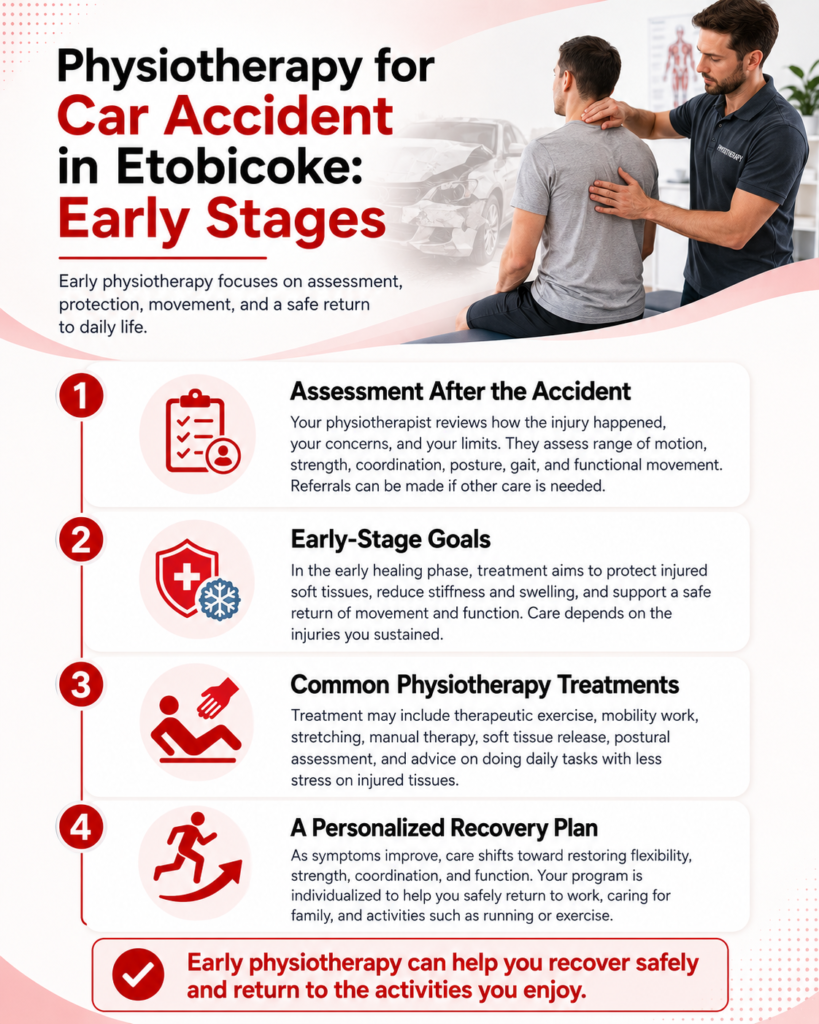
A physiotherapy assessment after a car accident can be used to understand what occurred, discuss your concerns, identify your limitations, and determine the most suitable course of action. The physiotherapist in Etobicoke will review the causes of the injury, assess your range of motion, coordination, and strength, and look at your posture, gait, walking pattern, and functional movement. If other health care practitioners’ involvement is required, you will be referred to them.
During the early stages of healing, physiotherapy aims to prevent additional soft-tissue damage while reducing stiffness and swelling. The treatment can be used to facilitate the movement and function return as per your specific condition. The approach can vary substantially from one individual to another and depends on the injuries sustained during the car accident.
Physiotherapy exercises for car accident victims in Etobicoke can include therapeutic exercises, mobility work, stretching, manual therapy, soft tissue release, postural assessments, and instruction on how to do daily tasks in a way that places minimal stress on the injured tissues. The physiotherapy for car accident in Toronto will also include strategies to gradually return you to all the activities you enjoy.
As the acute symptoms start resolving, the focus of physiotherapy shifts toward increasing and restoring flexibility, strength, coordination, and function. The physiotherapy after car accident Toronto program is individualized, so it can be tailored to your unique situation. If you are a construction worker, the physiotherapist will advise you on how to return to work while avoiding further stress on the injured area. If you are a mother of two, they will help you develop a personalized plan for caring for your children while recovering from the car accident. And if you are an avid runner, they will assist you in a returning to your favorite sport.
Physiotherapy for Car Accidents in Etobicoke: Later Stages
As you start feeling better, the physiotherapy program will gradually incorporate more advanced strengthening and conditioning techniques. You will slowly begin to perform more strenuous activities to get your body used to being active again. The specific stages will depend on your unique circumstance, so they can be substantially different for two individuals recovering from similar injuries. For example, a marathon runner and a sedentary office worker will have different plans even if they both sustained similar ligament sprains.
Physiotherapy Etobicoke professionals can help you get back to doing the things that you love. A competitive athlete would need to get back to running, jumping, and playing sports, while a construction worker would need to regain their lifting, carrying, and upper-body strength. The goals of physiotherapy for car accident in Etobicoke would be to get you back to an active lifestyle while reducing your risks of developing secondary conditions.
Why Do Some Injuries Take Longer to Heal After an Accident?
It is normal for the healing process to be cyclic. You may start feeling better on some days and then be sore and stiff on other days – especially when returning to work or being more active. Similarly, you may feel fine when you return to your regular activities, but then your symptoms can resurface when the weather changes or when you spend too many hours sitting at your desk. If you exercise regularly, return to work, or drive more frequently, you will slowly challenge your body and aggravate the injury site. Inflammation at the site of the injury can increase for a few days or weeks after additional stress is applied to it. This does not mean that you have reinjured yourself – it only means that your body needs extra care and attention.
If you have been dealing with pain for a substantially long time after the accident, there can be various reasons for that – prolonged tissue damage, reduced mobility, the development of secondary conditions such as nerve compression, or even prolonged poor sleep. You may also find that your symptoms are inconsistent with those expected from your injury. In all of those cases, it is best to consult your doctor or physiotherapist so they can review your condition and update your treatment plan.
Several symptoms that occur after a car accident require immediate medical attention, regardless of what happened during the incident. They include prolonged headaches, repeated vomiting, loss of consciousness, confusion, severe weakness, or numbness, sudden or severe worsening of symptoms, and new symptoms such as poor coordination or changes in vision. If you experience those issues, it is essential to seek medical assistance immediately. A similar situation occurs with the development of post-injury complications such as a second injury or the emergence of a new medical condition.
Your symptoms are also a good indicator of whether your injury is healing correctly. If you feel better – it is a sign that your treatment is working. That includes reduced pain and stiffness as well as improved range of motion, balance, and flexibility. You can also return to normal activities and work while engaging in light physical activities without experiencing discomfort.
If, however, your symptoms are consistent or worsening despite weeks of physiotherapy, it makes sense to reevaluate your situation. There can be several reasons for that – improper initial assessment, a concurrent injury, a change in the underlying condition, or even medication side effects. In all of those cases, it is best to talk with your physiotherapist and physician to rule out any potential concerns.
How Long Will It Take to Recover From a Car Accident? Final Remarks
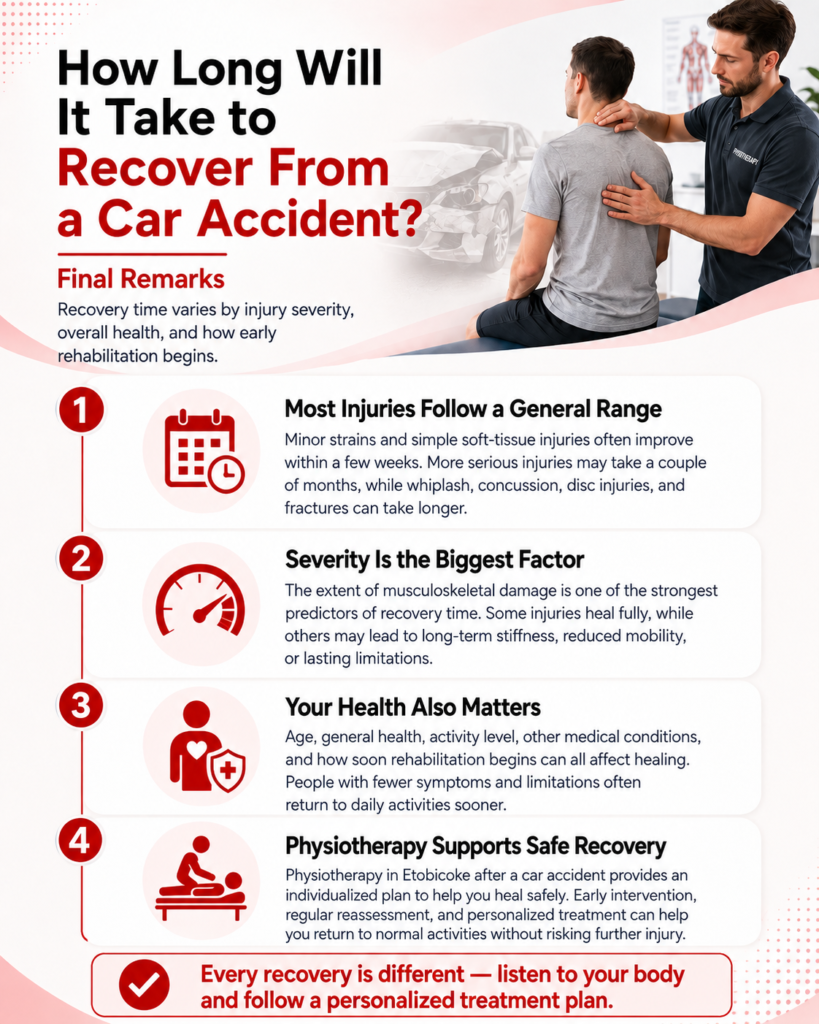
There is no definitive answer to how long it takes to heal from a car accident, but most injuries have a predictable range. In general, minor strains and simple soft-tissue injuries resolve within a few weeks, while more serious ones may take up to a couple of months to heal. More complex injuries such as whiplash, concussion, disc damage, and fractures take longer but rarely require more than a year. And then there are the injuries that have long-term or permanent effects, such as reduced mobility and range of motion.
The most important indicator of how long it takes to heal from a car accident is the extent of the musculoskeletal damage. However, it also depends on your general health, age, activity level, other conditions, and how aggressively you begin the rehabilitation process. Physiotherapy assessments and treatments can help you understand the nature and severity of your injury and develop a personalized plan of action. In most cases, those who recover faster from an injury are the ones who have fewer symptoms and limitations and can return to their everyday activities sooner. And remember, each case is different, so it is essential to listen to your body and not compare your injury with others’.
Most importantly, physiotherapy in Etobicoke after a car accident provides a safe, individualized approach to healing that can help you get back to your life. The right treatment plan in Toronto can allow you to gradually return to your regular activities without risking further injury. Early intervention, regular assessments, and personalized treatment programs will ensure you heal properly and safely.
FAQs
1. How long does soreness last after a car accident?
Minor muscular soreness usually develops several hours or day after the crash. It typically resolves within 2-4 weeks, but it can persist for a few months. Soreness lasting for more than a few months is rarely due to an injury, but it can affect your daily activities.
2. Can whiplash take months to recover from?
Yes, since it is a complex injury with a wide range of contributing factors.
In most cases, milder symptoms of whiplash resolve within several weeks, but dizziness, headaches, and restricted neck movement can linger for several months. Chronic whiplash can also develop as a result of prolonged pain and the inability to return to your regular activities. In all cases, physiotherapy in Etobicoke and Toronto can help you return to an active lifestyle.
3. Should I rest after a car accident?
Complete rest should only be done if advised by a medical professional because it can hinder the healing process in most cases. It is normal to modify your activities after an accident, but prolonged inactivity can contribute to poor circulation, muscle atrophy, deconditioning, and poor recovery. The duration and type of activity modification should be determined by a physiotherapist.
4. When should I start physiotherapy after a car accident?
Physiotherapy can be started right away in most cases to reduce pain, improve function, and encourage healing. The initial stages are often focused on assessments, education, and gentle movements to address the acute symptoms. More strenuous activities are introduced as your condition permits.
5. Why does my neck hurt more after a car accident?
Muscle soreness and stiffness are common after an injury as your body begins to heal. Poor circulation and restricted movement can contribute to delayed pain, especially after prolonged inactivity or return to work. While it is common to experience soreness several days or weeks after a car accident, sudden worsening of symptoms may indicate a more serious issue.
6. How long does lower back pain last after a car accident?
It depends on the nature and severity of the injury, but most people experience improvement within several weeks. In some cases, it can last for a few months, especially if you have a pre-existing condition such as osteoarthritis or a degenerative disc disease. A more serious injury, on the other hand, could take longer to heal.
7. Can I exercise while recovering from a car accident?
Yes, but it depends on the stage and nature of your recovery. In most cases, you will be encouraged to perform therapeutic exercises, stretches, light aerobic activities, and gradually reintroduce strength-building activities. Physiotherapy for car accident in Etobicoke will help you design a personalized program of therapeutic exercises.
8. Why am I still experiencing pain 3 months after a car accident?
There can be many reasons for that, ranging from the presence of multiple injury sites to the prolonged effects of poor healing. Chronic pain can be a symptom of poor sleep, altered mental health, or nerve damage, and it can persist for months or years after an accident. Physiotherapy near me in Toronto will be able to address these issues and update your treatment plan.
9. How do I know whether my car accident injuries are healing?
You should base your decision on how you feel rather than on how much time has passed since the crash. If your symptoms are gradually improving, and you can function better, it is a sign that healing has begun. It means your range of motion and flexibility have improved, you can return to work, exercise, and other activities of daily living.
10. When should I seek urgent medical attention after a car accident?
Seek emergency medical assistance if you experience severe headache, repeated vomiting, loss of consciousness, confusion, worsening weakness, numbness, vision changes, poor coordination, or difficulty walking or talking. Similar concerns include extreme pain, swelling, chest pain, breathing difficulties, and loss of bladder or bowel control after a car accident.