


Physiotherapy Near Kingsway: What Local Residents Should Know
Physiotherapy Near Kingsway: What Local Residents Should Know
The Kingsway is among Etobicoke’s most established residential communities, recognised for its mature tree canopy, Tudor Revival architecture, and generations of long-term homeowners settled along the Humber River corridor. For residents of this neighbourhood, understanding what a proper course of physiotherapy actually involves matters as much as knowing where to find it.
This guide explains what Kingsway residents should understand before choosing a Physiotherapy clinic in Etobicoke, including the conditions most frequently seen in this community, what a clinically sound assessment involves, and how residents can access qualified physiotherapy care from this part of the city.
Key Takeaways
- The Kingsway’s large properties, active golf and tennis club culture, and long-established resident base create a distinct pattern of overuse, joint, and age-related conditions.
- A qualified physiotherapist must be registered with the College of Physiotherapists of Ontario, which should be confirmed before booking any assessment.
- Effective treatment begins with a comprehensive clinical assessment, not a generic exercise handout.
- Common conditions in this community include mechanical lower back pain, golfer’s and tennis elbow, hip and knee osteoarthritis, and post-surgical joint rehabilitation.
- Residents typically travel a short, familiar distance along the Bloor Street West corridor or the Gardiner Expressway to reach a full-service clinic.
Show Image
The Kingsway’s Lifestyle and Its Physiotherapy Implications
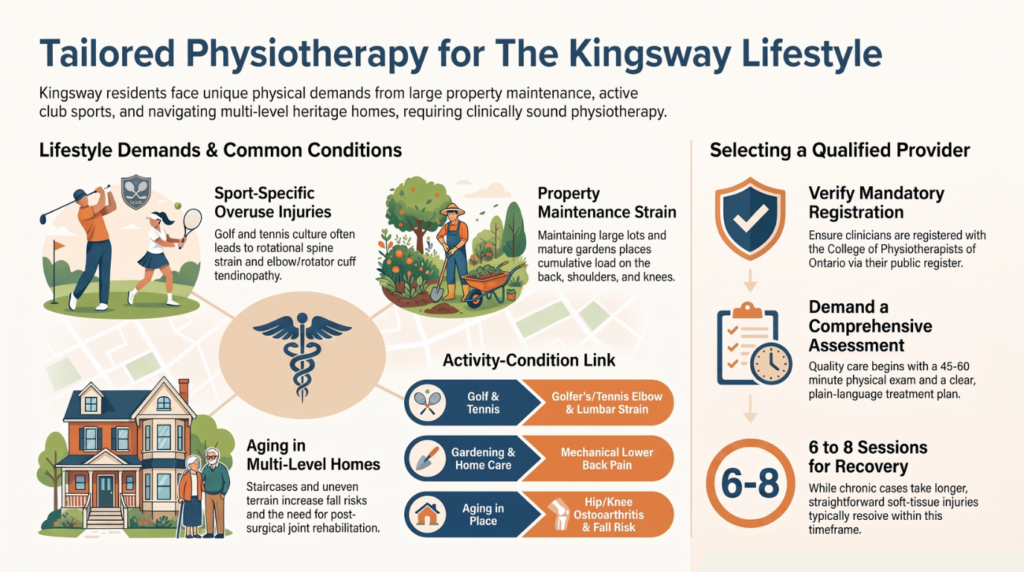
The Kingsway occupies a distinct place among Etobicoke neighbourhoods, characterised by expansive lots, mature gardens, and a strong concentration of detached, multi-storey homes along Government Road, Kingsway Crescent, and the surrounding grid. Residents who maintain these properties personally are routinely exposed to repetitive strain from gardening, lawn care, and seasonal outdoor labour, all of which place cumulative load on the lower back, shoulders, and knees.
The neighbourhood’s proximity to private golf and tennis clubs further shapes its clinical profile. Golf swings generate substantial rotational torque through the lumbar spine and lead elbow, while tennis places repetitive strain on the wrist extensors and rotator cuff. Both activities, practised regularly over decades, produce a recognisable set of overuse conditions that a physiotherapist familiar with an active, club-oriented population is well positioned to anticipate.
A further defining feature of The Kingsway is its high proportion of long-tenured residents ageing in place within large, multi-level homes. Staircases, uneven garden terrain, and properties built before modern accessibility standards existed introduce fall risk and mobility considerations that become clinically more relevant with advancing age, particularly following joint replacement surgery or the onset of osteoarthritis.
What Kingsway Residents Should Look for in a Physiotherapy Provider
Before booking an appointment, residents should confirm that a physiotherapist is currently registered with the College of Physiotherapists of Ontario, the regulatory body responsible for licensing physiotherapy practice across the province. The College maintains a free public register that allows anyone to verify a practitioner’s registration status and review any disciplinary history within a minute.
Registration alone does not indicate suitability for a specific condition. Residents managing a golf-related injury, a hip replacement recovery, or a chronic lower back complaint should ask directly about a clinician’s experience treating that presentation, and what a realistic treatment timeline looks like before committing to a full course of sessions.
Equally important is how clearly a physiotherapist communicates clinical reasoning. A well-run initial assessment should produce a plain-language explanation of findings, a structured treatment plan with defined goals, and a transparent account of expected session frequency, rather than a vague assurance that improvement will simply come with time.
Show Image
Common Conditions Treated and What a Course of Treatment Typically Involves
Given the demographic and lifestyle patterns described above, physiotherapists serving this community routinely treat mechanical lower back pain, hip and knee osteoarthritis, rotator cuff tendinopathy, and both golfer’s and tennis elbow. Post-surgical rehabilitation following hip or knee replacement is also common, reflecting the neighbourhood’s older, well-established resident base and its emphasis on maintaining an active lifestyle well into later life.
Treatment for these presentations generally follows a structured sequence: a comprehensive subjective and physical assessment, identification of contributing biomechanical factors, and a progressive exercise programme designed to restore strength, range of motion, and function. Manual therapy techniques are frequently incorporated alongside active rehabilitation, particularly during the earlier stages of recovery from an acute episode.
Recovery timelines vary considerably by condition and by individual factors such as age, baseline activity level, and adherence to a home exercise programme. Straightforward soft-tissue injuries may resolve within six to eight sessions, while post-surgical rehabilitation or chronic joint conditions typically require a longer, more structured course of care extending over several months.
Accessing Physiotherapy Care From The Kingsway
The Kingsway sits at the eastern edge of Etobicoke, bordered by Islington Avenue and the Humber River, with direct access to the Bloor-Danforth subway line at Royal York and Old Mill stations and a short drive to the Gardiner Expressway. This connectivity means residents are not limited to providers within the immediate neighbourhood when selecting physiotherapy care.
A Physiotherapy clinic in Etobicoke such as Rapha Rehab, located further west along the same Bloor Street West corridor in the Markland Wood area, is a realistic option for Kingsway residents willing to travel this corridor or via the Gardiner Expressway and Highway 427. The distance is comparable to many residents’ existing commute patterns within the city.
Regardless of which provider a Kingsway resident ultimately chooses, the same standard applies: confirmed registration, a clear and thorough assessment process, and a treatment plan built around the specific physical demands of this community’s lifestyle, whether that involves a return to the golf course, recovery from joint replacement, or simply maintaining an active, independent home life.
Conclusion
Physiotherapy needs in The Kingsway are shaped by a genuinely distinct set of factors: substantial properties requiring physical upkeep, an active golf and tennis culture, and a resident base that skews toward long-term homeowners ageing in place. Recognising these patterns allows both residents and clinicians to approach treatment with appropriate context, rather than applying a generic protocol to a population with particular physical demands. Whether the goal is returning to eighteen holes, recovering from a joint replacement, or simply managing everyday mobility, the fundamentals remain consistent: verified credentials, a thorough assessment, and a treatment plan built around realistic, individual goals.
Frequently Asked Questions
Do Kingsway residents need to travel far for quality physiotherapy care? Not excessively. The Kingsway’s position along the Bloor-Danforth subway line and its proximity to the Gardiner Expressway mean residents can reach full-service clinics elsewhere in Etobicoke within a travel time comparable to their existing daily commute patterns.
What conditions are most common among The Kingsway’s residents? Given the neighbourhood’s large properties and active golf and tennis culture, mechanical lower back pain, golfer’s and tennis elbow, rotator cuff tendinopathy, and hip or knee osteoarthritis are frequently seen, alongside post-surgical joint replacement rehabilitation in this established population.
How can I verify a physiotherapist’s registration in Ontario? Search the College of Physiotherapists of Ontario’s public register, which is free and takes under a minute. It confirms current registration status and discloses any conditions or disciplinary history attached to a practitioner’s licence.
Is physiotherapy effective for golf-related injuries? Yes. Physiotherapy addresses the rotational lumbar strain and lead-elbow overuse common in golf by correcting contributing movement patterns and building targeted strength and flexibility, rather than only managing the current symptom in isolation.
How does physiotherapy help after a hip or knee replacement? Post-surgical physiotherapy restores range of motion, rebuilds surrounding muscle strength, and guides a safe, progressive return to walking and daily activity, meaningfully influencing how fully and how quickly function is regained after joint replacement surgery.
Are older adults in established neighbourhoods like The Kingsway at higher risk of certain injuries? Ageing in place within large, multi-level homes can introduce fall risk from staircases and uneven garden terrain. Physiotherapy addressing balance, strength, and mobility can meaningfully reduce this risk for long-term residents.
How many physiotherapy sessions are typically needed for a lower back strain? Straightforward mechanical lower back strain often improves within six to eight sessions, though this depends on severity, prior history, and how consistently a home exercise programme is followed between appointments.
Should I see a physiotherapist for gardening-related shoulder or back pain? Yes, particularly if discomfort persists beyond a few days or recurs each season. A physiotherapist can identify the specific movement patterns responsible and address them before the issue becomes a chronic, recurring problem.
Does OHIP cover physiotherapy for Kingsway residents? Only for specific groups — those 19 and under, 65 and older, ODSP or Ontario Works recipients, and recent hospital discharges — and only at designated clinics. Most adults rely on extended health benefits or private payment.
What should I expect during my first physiotherapy assessment? A first visit typically runs 45 to 60 minutes and includes a detailed history, a physical examination of movement and strength, and a clear explanation of findings alongside an initial treatment plan tailored to your specific condition.