


Physiotherapy for Mimico & Humber Bay Shores Residents
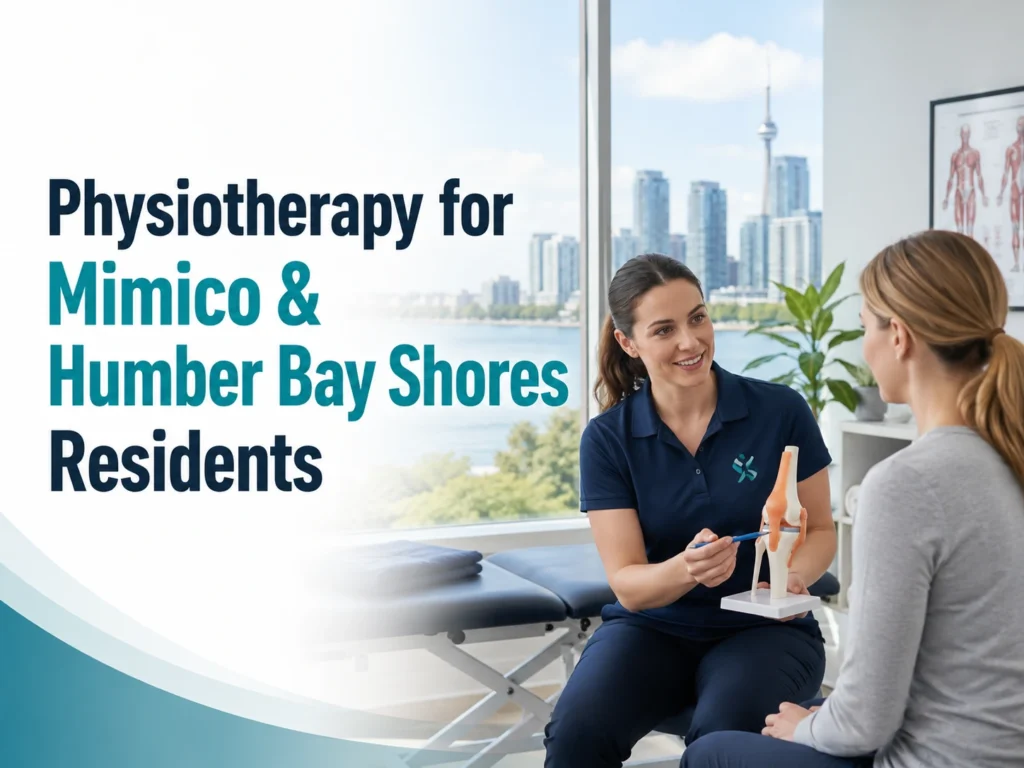
Physiotherapy for Mimico & Humber Bay Shores Residents
Mimico and the adjoining Humber Bay Shores district form one of Etobicoke’s most active waterfront communities, home to a dense cluster of highrise condominiums, an extensive lakeside trail network, and a resident base known for running, cycling, and outdoor recreation throughout the year. This lifestyle brings a distinct set of physiotherapy needs that differ meaningfully from those seen elsewhere in Etobicoke.
This guide outlines what Mimico and Humber Bay Shores residents should understand before choosing a Physiotherapy clinic in Etobicoke, including the conditions most frequently linked to this community’s active routines, what a clinically sound assessment involves, and how residents can access qualified physiotherapy care from this part of the city.
Key Takeaways
- Mimico and Humber Bay Shores’ waterfront trail culture and highrise condo lifestyle create a distinct pattern of overuse and activity-related injuries.
- The “weekend warrior” pattern — sedentary weekdays followed by intense weekend activity — is a recognised risk factor within this commuter-heavy community.
- A qualified physiotherapist must be registered with the College of Physiotherapists of Ontario, which should be confirmed before booking any assessment.
- Common conditions include runner’s knee, iliotibial band syndrome, Achilles tendinopathy, and gym-related shoulder or lower back strain.
- Residents typically reach full-service clinics via the Gardiner Expressway and Highway 427 corridor rather than relying solely on providers within the immediate waterfront district.
Mimico and Humber Bay Shores’ Active Lifestyle and Its Physiotherapy Implications
Humber Bay Shores has developed into one of South Etobicoke’s most densely populated waterfront districts, anchored by a continuous trail network running directly along Lake Ontario. Residents make consistent year-round use of this trail for running, cycling, and rollerblading, producing a volume of repetitive lower-limb loading that is considerably less common in more suburban parts of Etobicoke, and one that carries its own distinct injury profile.
A second contributing factor is the commuter profile of this community. Many residents travel daily into downtown Toronto via the Gardiner Expressway or GO Transit, spending long sedentary hours at a desk before returning home to an intensely active weekend of running, cycling, or structured gym training. This pattern, often described clinically as the “weekend warrior” effect, is a well-recognised contributor to both acute strains and cumulative overuse injury.
The density of highrise condominium living in Humber Bay Shores also shapes local injury patterns in ways that differ from Etobicoke’s more suburban neighbourhoods. Most buildings include on-site fitness facilities that encourage regular strength training and group fitness classes, which, without proper progression or technique correction, commonly produce shoulder, lower back, and knee complaints. This combination of trail-based cardiovascular activity and condo-based strength training gives physiotherapists serving this area a genuinely distinctive caseload.
What Mimico & Humber Bay Shores Residents Should Look for in a Physiotherapy Provider
Before booking an appointment, residents should confirm that a physiotherapist is currently registered with the College of Physiotherapists of Ontario, the regulatory body responsible for licensing physiotherapy practice throughout the province. The College’s free public register allows anyone to verify a practitioner’s current standing and review any disciplinary history within a minute, at no cost to the person searching.
Given the prevalence of running and cycling-related presentations within this community, it is worth asking specifically about a physiotherapist’s experience with gait analysis, biomechanical assessment, and structured return-to-running protocols. A clinician accustomed to treating recreational athletes will typically structure rehabilitation quite differently than one whose practice focuses mainly on general orthopaedic or post-surgical populations.
Communication quality also matters considerably in this context. A properly conducted first assessment should produce a clear explanation of the biomechanical factors contributing to your specific injury, a structured and progressive treatment plan, and realistic expectations for returning to running, cycling, or gym training, rather than a generic instruction to simply rest until symptoms subside on their own.
Common Conditions Treated and What a Course of Treatment Typically Involves
Physiotherapists serving Mimico and Humber Bay Shores regularly treat patellofemoral pain syndrome, commonly known as runner’s knee, alongside iliotibial band syndrome, Achilles tendinopathy, and shin splints, all closely associated with heavy trail usage. Shoulder impingement and lower back strain linked to condo gym training are similarly frequent presentations within this active, fitness-oriented population.
Treatment typically begins with a detailed assessment of running or cycling mechanics alongside standard strength and mobility testing, since biomechanical inefficiencies are frequently the underlying driver of repetitive strain injuries rather than the activity itself. A progressive loading programme is then built around gradually restoring tissue capacity, rather than simply resting until acute symptoms resolve and then resuming prior training unchanged.
Recovery timelines depend heavily on injury duration and training load prior to onset. Straightforward cases of runner’s knee or shin splints often improve within six to eight sessions when combined with temporary activity modification, while chronic Achilles tendinopathy or recurring lower back strain may require a considerably longer, more structured rehabilitation programme extending over several months.
Accessing Physiotherapy Care From Mimico and Humber Bay Shores
Mimico and Humber Bay Shores sit along the southeastern edge of Etobicoke, bordered by Lake Ontario and the Humber River, with strong access to the Gardiner Expressway, GO Transit’s Lakeshore West line, and the 501 Queen streetcar. This connectivity means residents are rarely limited to physiotherapy providers within the immediate waterfront district when selecting appropriate care.
A Physiotherapy clinic in Etobicoke such as Rapha Rehab, located further north along Bloor Street West in the Markland Wood area, remains accessible to Mimico and Humber Bay Shores residents via the Gardiner Expressway and Highway 427, a route broadly consistent with many residents’ existing commute into or out of the downtown core.
Whichever provider a resident of this community ultimately selects, the underlying standard should remain consistent: confirmed registration, a thorough biomechanical assessment, and a treatment plan built specifically around the physical demands of a running, cycling, or condo-gym-based lifestyle, rather than a generic approach disconnected from how residents actually use their bodies day to day.
Conclusion
Physiotherapy needs in Mimico and Humber Bay Shores are shaped by a genuinely active, waterfront-oriented lifestyle: extensive trail use, a pronounced weekend warrior commuting pattern, and a strong condo gym culture. Recognising these factors allows both residents and physiotherapists to approach treatment with appropriate context, rather than treating every complaint as a generic, unspecified strain. Whether the goal is returning to a regular running route, recovering from a cycling-related injury, or resolving persistent gym-related shoulder pain, the fundamentals remain the same: verified credentials, a thorough biomechanical assessment, and a treatment plan built around realistic, activity-specific goals.
Frequently Asked Questions
Do Mimico and Humber Bay Shores residents need to travel far for physiotherapy? Not excessively. With strong Gardiner Expressway and Highway 427 access, residents can typically reach a full-service clinic elsewhere in Etobicoke within a travel time comparable to their existing commute into downtown Toronto.
What conditions are most common among active waterfront residents in this area? Given extensive trail use for running and cycling, patellofemoral pain (runner’s knee), iliotibial band syndrome, Achilles tendinopathy, and shin splints are frequently seen, alongside gym-related shoulder and lower back strain from condo fitness facilities.
What is the “weekend warrior” pattern, and why does it matter for injury risk? It describes long sedentary weekdays followed by intense weekend physical activity, common among commuters in this district. The sudden jump in load without adequate conditioning is a recognised contributor to both acute strains and overuse injury.
How can I verify a physiotherapist’s registration in Ontario? Search the College of Physiotherapists of Ontario’s public register, which is free and takes under a minute. It confirms current registration status and discloses any disciplinary history attached to a practitioner’s licence.
Is physiotherapy effective for runner’s knee? Yes. Physiotherapy addresses the underlying biomechanical factors, often hip and core weakness or altered running mechanics, rather than only managing pain, which typically produces more durable long-term improvement than rest alone.
Does physiotherapy help with cycling-related injuries? Yes. A physiotherapist can assess bike fit, pedalling mechanics, and muscular imbalances that commonly underlie knee, hip, and lower back complaints in regular cyclists, then build a targeted correction and strengthening programme around those findings.
Should gym-related shoulder pain be treated by a physiotherapist? It’s worth assessing promptly, particularly if pain persists beyond a few sessions or worsens with specific lifts. A physiotherapist can identify contributing technique or mobility issues before the presentation develops into a chronic impingement.
How many sessions are typically needed for Achilles tendinopathy? Recovery varies with duration and severity, but Achilles tendinopathy often requires a longer course than acute injuries, given the tendon’s slower healing response, frequently extending over several months of progressive loading exercise.
Does OHIP cover physiotherapy for Mimico residents? Only for specific groups — those 19 and under, 65 and older, ODSP or Ontario Works recipients, and recent hospital discharges — and only at designated clinics. Most adults rely on extended health benefits or private payment.
What should I expect during my first physiotherapy assessment? A first visit typically runs 45 to 60 minutes and includes a detailed history, a physical and movement assessment, and a clear explanation of findings alongside an initial treatment plan tailored to your specific activity and goals.