


Ankle Sprain Recovery: A Week-by-Week Home Exercise Guide
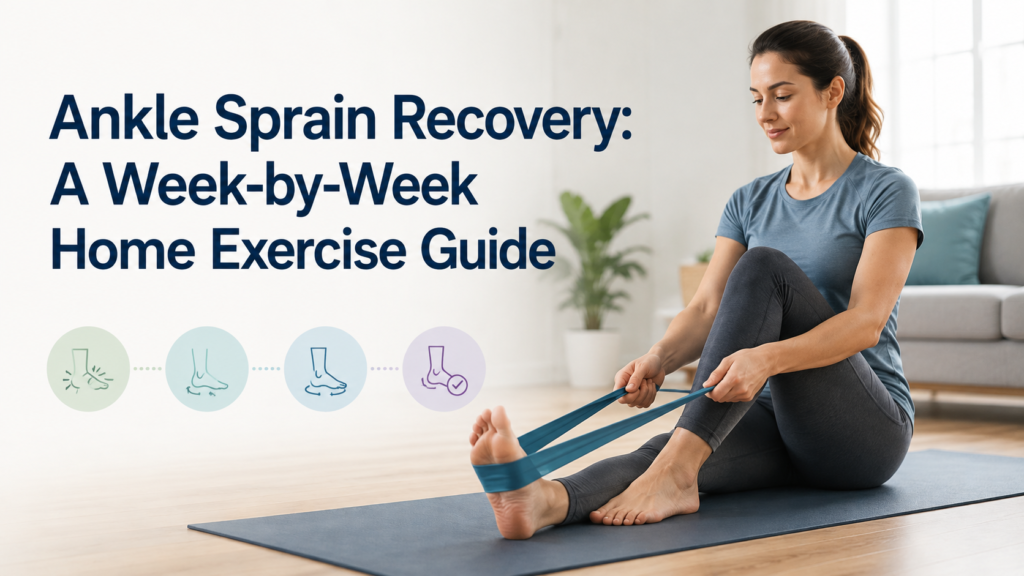
Ankle Sprain Recovery: A Week-by-Week Home Exercise Guide
An ankle sprain can occur suddenly when people miss a step or slip on the ground, or during a sporting activity when the ankle rolls inwards. Pain, swelling, bruising, stiffness, and worries over the possible implications of the injury can last for days or even weeks.
Most simple ankle sprains do not require surgical intervention, but it is unwise to simply wait for the pain to fade. Controlled mobility, progression of load-bearing activity, and strengthening exercises can hasten the return to normal function and reduce the chance of recurrent ankle sprains. The recovery time depends on many factors, including the severity of the injury, physical condition, history of ankle sprains, and ankle function during progressive increase in activity.
This guide aims to present an approximate timeline for ankle sprain recovery following a simple lateral ankle sprain. Those with concerns over the extent of injury or slow recovery following substantial damage must see a medical practitioner to discuss the best rehabilitation options. Minor sprains can take a few weeks to heal, while more severe cases might require six months or more before resuming strenuous activity.
Key considerations before starting ankle sprain exercises
The level of exercise intensity should depend on the pain, swelling, weight-bearing capacity, and overall improvement in the joint function rather than the number of days since the injury.
Some minor discomfort or stiffness is normal during the rehabilitation process, but sharp or severe pain, especially after exercise, should be cause for concern. If the ankle swells significantly more after an activity, it is best to reduce the intensity and wait before trying again. Severe sprains, high ankle sprains, concurrent fractures, recurrent injuries, and post-surgical cases require a specialist’s individual assessment of the condition.
Balance must be prioritized during ankle sprain rehabilitation, as the joint might feel unstable even when the ligaments heal correctly without intervention. It can take weeks or even months to regain full confidence in the joint’s function.
Week 1: Protect the ankle and regain range of motion
The primary goals during the first week are managing pain and swelling, protecting the joint, and preventing stiffness. Some mild swelling and bruising are to be expected, especially with more severe sprains, and can be reduced with elevation and compression. Cold therapy can help reduce discomfort in the short term but should never be applied directly on the skin.
The ankle joint should not be offloaded for extended periods unless the injury is severe. Putting some weight on the affected foot while walking with mild pain should begin as soon as possible. Using crutches or a supportive brace can be necessary in some cases where weight-bearing is painful. Orthopaedic surgeons usually recommend avoiding prolonged immobilization when managing simple ankle sprains.
Those with doubts over their ability to resume everyday activities should see a professional who specializes in sports injuries. A physiotherapist can examine the range of motion, assess pain perception, and determine the extent of damage and implications for recovery. Those in the Etobicoke region searching for an ankle injury physio can try Physiotherapy Etobicoke for an assessment if pain, weakness, or instability persists after a few weeks.
Days 1–3: Regain pain-free range of motion
Simple ankle pumps while sitting or lying down can get the joint moving, reduce stiffness, and promote circulation. Point the toes away from the body and then towards it, repeating this motion 10–20 times several times daily. Ankle pumps should be performed with a comfortable range of motion and should not put stress on the injured area. Ankle circles, where the foot makes rotational movements in both directions, and toe alphabet tracing can also help during the early stages of recovery.
The goal during this stage is to reduce stiffness and gradually increase the range of motion within a pain-free degree. Ankle movements should not put stress on the ligaments or cause sharp pain. Range of motion exercises can begin a few days after the injury with very gentle motions.
Days 4–7: Gradual load-bearing and strengthening
Those who can stand independently with minimal pain can begin challenging their balance by standing side on to a counter. They can shift weight to the affected leg and then return to the middle, increasing the amount of weight with time. Similar balance challenges can be attempted while sitting. Seated heel raises can also be attempted by raising and lowering the heels while sitting with the legs bent and the feet flat on the floor. About 10–15 repetitions can be performed, followed by toe raises, where the front of the feet is lifted while keeping the heels down.
The way one walks can also be used to test and gradually increase the load on the ankle. The focus should be on taking longer steps rather than walking for longer periods with small steps. Walking with a limp for long periods is not beneficial for an ankle sprain, especially if there is still pain with every step.
Week 2: Increase mobility while beginning strengthening
Most minor sprains will present with little to no swelling or pain by the second week. The primary focus can shift towards regaining full range of motion and introducing strengthening exercises. Moderate sprains will likely still be swollen, so it is unwise to rush into the next stage of rehabilitation if mobility is limited. Those who still experience significant discomfort when walking should consult a medical practitioner to find out what impedes ankle function.
Calf stretches can be introduced when gentle range of motion is no longer limited by pain. Standing facing a wall with the injured leg behind the sound one, the stretch targets the calf muscles. Keeping the back leg straight, the body is leaned forward until a stretch is felt, holding this position for 20–30 seconds before returning to the starting position. A variation of this stretch with the knee bent can target a different part of the calf.
Sharp pain or popping noises during stretching signify that the movement is too extreme and should be avoided. Upward movement of the shin during regular walking is essential for stepping, climbing stairs, squatting, and jumping. Strengthening dorsiflexion – the movement of the big toe towards the shin – can help restore this ability while also preventing other joints from overcompensating during movement.
Strengthening exercises for ankle sprain
Those who can move the ankle freely can begin strengthening exercises, targeting different movements with resistance bands. A band can be placed around the foot and used to perform dorsiflexion and plantarflexion against its tension. Similar motions can be performed to resist inversion and eversion, moving the front of the feet inwards and outwards.
The bands provide light resistance, but those with a higher level of fitness or a sound musculoskeletal system can challenge their balance and strength further. Outward ankle ligaments are often injured during lateral sprains, making the joint unstable, so this movement should be attempted with caution. The exercises should not cause any pain over the injured ligaments and should be performed in a controlled manner.
One or two sets of 10 repetitions can be attempted before progressing to higher resistance or more repetitions. The goal is to improve the quality of movement rather than fatigue the muscles. All the joints in the lower limbs contribute to the function of the ankle, and their combined strengthening is needed to return to sports or other strenuous activities.
Standing heel raises
When the ankle is mobile and free from pain, double-leg heel raises while holding a counter or a firm chair can be introduced. Raise the legs by bending at the knees and ankles before lowering slowly. About 10 repetitions can be attempted before progressing to single-leg raises with the same leg on the floor. The objective is to develop strong calves, which provide the power for most movements requiring the lower limbs.
The ability to stand on the toes is essential for many activities, including stair climbing, walking, and jumping. Those who resume activity before strengthening their calves often discover that this muscle group is insufficient for their desired level of performance.
Weeks 3–4: Improve balance and functional strength
Many individuals with simple ankle sprains will be able to walk fairly easily by the third week, albeit with some discomfort or stiffness. The emphasis can shift to improving balance, as well as functional strength that targets the movements performed during regular activity. Ankle sprains can affect proprioception, the mechanoreception of the joints, leading to feelings of instability even after the ligaments heal.
Balance should be challenged during this stage, as it is the foundation for functional movement. Orthopaedic surgeons recommend proprioception and balance rehabilitation to prevent recurrent sprains.
Single-leg balance
Stance on the affected leg while holding a counter with the opposite hand can be attempted, trying to hold the position for 20–30 seconds. The knees should be slightly bent rather than locked, as this movement puts less stress on them. As balance improves, less support can be taken by the upper body, and the range of motion can be increased.
The difficulty can also be adjusted by standing on a thicker towel or even an unstable surface. It is unwise to try and challenge proprioception drastically right away as a slightly wobbly stance is sufficient to begin with. Turning the head or moving the arms can also be used to test whether the body can maintain stability.
Mini squats, step-ups, and step-downs
Mini squats can help improve strength and coordination at the hips, knees, and ankles. The feet should be positioned slightly narrower than hip-width, and the knees should be bent at a slight angle. The squat should be performed slowly with a controlled movement, focusing on keeping the heels down as much as possible. Similar single-leg squats can also be attempted to challenge the balance further.
Step-ups can also be introduced using a low step or a staircase. Step on with the injured leg, bending the knee and hip, and lower back down in a controlled manner. Step-downs can be used to prepare the ankle for more strenuous activity, working on the muscles in the legs and the balance of the joints.
The movement of the whole lower limb should be considered when performing each exercise. Ankle, knee, and hip joints are interrelated, with each playing a role in stability and power development during different movements. It is not enough to strengthen the affected ligaments; the whole lower limb must be resilient to resume sports.
Weeks 5–8 and beyond: Prepare for running, sport, and return to activity
The last stage of ankle sprain rehabilitation is preparing the joint for running, sport, or other strenuous activity. The emphasis is on restoring the strength, speed, as well as proprioception and balance needed for dynamic movements. Ankle sprains can take significantly longer to heal depending on their severity – most minor cases should be almost back to normal by the fifth or sixth week. Those with more serious damage might need another six months before they can return to sports.
Individuals should be able to walk briskly without a limp, perform several heel raises, and have sufficient balance to single-leg stance before attempting to run. Those who are limping constantly after a few months or unable to perform simple functional movements should seek a specialist’s opinion to rule out complications. The ability to jump, land, and change direction with a reasonable degree of confidence is also essential.
Physiotherapy Etobicoke can be contacted to locate a physiotherapist near me for a thorough assessment if standard measures fail to help. Those with persistent pain and swelling or an inability to stand on the affected leg or move up and down stairs should also see a medical practitioner.
Low-impact conditioning before returning to sports
Stationary biking, swimming, or other forms of conditioning can be used to restore cardiovascular fitness while putting little stress on the ankle. Time spent on these activities can be increased gradually, assessing how the ankle feels later the same day or the following morning.
Brisk walking can then be introduced before transitioning to running on a flat surface. It is unwise to attempt trails and other uneven terrain or engage in competitive games or races right away. The same principle can be used when developing speed and agility – the change in direction and movement should be attempted one at a time rather than introducing multiple new elements.
Hopping and directional changes
Sprinting, agility, and sport-specific drills can be introduced when the whole body is prepared, focusing on the control and stability of the ankle joint. Two-legged hopping can be used at first before progressing to single-leg movements, alternating between forward/backward and side-to-side hopping.
Figure-eight running and lateral movements can also be incorporated with sport-specific changes in direction, accelerating, and decelerating. This phase of rehabilitation is crucial for returning to sports, as it prepares the ankle for the dynamic and varying movements required for most activities. Those who return to activity too soon often rediscover their ankle’s instability, especially when changing direction at speed.
It is unwise to resume sport before being able to hop comfortably and perform directional changes without pain or excessive swelling. Ankle taping or bracing for sprained ankles can also be considered to reduce instability during the early stages of returning to sports, especially for those with a history of recurrent injuries.
Continuing rehabilitation after full return to activity
Rehabilitation need not stop once the ankle is back to normal – calf raises, resistance exercises, and single-leg balance can be performed several times a week to maintain joint function. Ankle sprains can considerably affect a person’s life, especially if they are prone to recurring injuries and have to stop physical activity for an extended period. Chronic pain following multiple ankle sprains often requires further intervention to restore joint function and reduce swelling.
Wearing appropriate footwear, warming up before activity, and assessing the load are all a part of ankle sprain recovery, as well as sport-specific conditioning. Strengthening exercises, single-leg balance, and proprioception work should not be discontinued upon resuming activity, especially for those engaging in sports or other strenuous activities.
Those returning to basketball, soccer, tennis, running, hiking, or working in conditions requiring uneven ground should be especially careful during this stage, as the ankle might still be more susceptible to injury.
When should an ankle sprain be professionally assessed?
Not every knee injury presents similarly, and those with severe pain, inability to bear weight, significant deformity, excessive swelling around the joint, numbness, or pale skin should see a medical practitioner. Anyone experiencing worsening symptoms or those who suspect a bone or ligament damage should also seek medical attention. Similar concerns arise if a person cannot return to regular activities several weeks after the incident or the injured leg becomes swollen and painful without an apparent cause.
AAOS recommends seeing a healthcare professional if substantial pain or swelling persists despite conservative management or if the ability to bear weight is still limited. A physiotherapist can assess joint range of motion, muscle strength, walking pattern, and the ability to return to sports or other activity. Ankle sprain rehabilitation can then be progressed following this assessment rather than a generic timeline based on the number of days since the injury.
Conclusion
The rehabilitation of an ankle sprain should not be rushed, and the first week should focus on protecting the injured joint, reducing swelling, and returning the range of motion to near-normal. The second week can see a gradual introduction of strengthening exercises alongside mobility work while challenging balance and single-leg stance. Improving functional movement patterns and proprioception is the focus of weeks three and four.
Those who successfully complete these stages can begin preparing for running and sport during the fifth week, using low-impact conditioning before progressing to higher intensity activity. Ankle sprains can take anywhere between several weeks and six months to heal depending on their severity, and rushing the rehabilitation can cause further damage.
The most vital signs of improvement are increased mobility, reduced swelling and pain, normal gait, and single-leg balance. Enhanced strength and confidence during functional movements are also telling signs, and those who do not notice them should consult a medical specialist to determine the cause. Ankle sprain rehabilitation should depend on individual progress during each stage rather than the number of days since the injury.
FAQ
- How long does an ankle sprain take to heal?
The healing time for an ankle sprain depends on the severity of the injury, with minor sprains taking a few weeks to heal and more severe cases taking up to six months or more before returning to sports.
- Should I start exercising my ankle immediately after a sprain?
Gentle range of motion exercises can be attempted soon after the injury to reduce stiffness, but strengthening should be introduced gradually.
- Can I walk on the ankle when I have a sprain?
Weight bearing is common practice for simple ankle sprains, but it should be attempted only when possible without substantial pain. If walking causes severe discomfort or inability to bear weight, consult a medical practitioner.
- What is the best first exercise for an ankle sprain?
Ankle pumps while sitting or laying down can be the first movement, trying to achieve a comfortable range of motion. Ankle circles and tracing the alphabet with the big toe can also be introduced.
- When can I start doing calf raises?
Double-leg calf raises can be attempted when standing and walking are comfortable, with the aim of increasing the range of motion and number of repetitions before single-leg raises.
- Why is balance crucial during ankle sprain rehabilitation?
Ligaments play an essential role in proprioception – a person’s sense of their body in space – and most ankle sprains affect this ability. The joint can feel unstable even after the ligaments heal, so it is vital to challenge balance during recovery.
- When should I start running?
Running should be resumed when brisk walking is comfortable and ankle movement is near normal, and sufficient strength and balance have been restored.
- Should ankle sprain exercises be painful?
Mild pain or stiffness can arise during rehabilitation, but sharp or persistent pain is not a normal physiological response. A physiotherapist or doctor should be contacted in such cases, and it is unwise to continue painful exercises.
- Why does my ankle still swell weeks after a sprain?
Swelling can persist even several weeks after an ankle injury, but increasing pain and swelling after a few weeks can indicate complications. A medical practitioner should be contacted to rule out additional damage.
- How can I prevent another ankle sprain?
Regular range of motion, strengthening, and balance exercises should be continued even after the ankle has healed. Returning to sport and other strenuous activity should be gradual, and those with a history of ankle sprains should be especially careful.