


How Does Direct Billing for Physiotherapy Work?
- Home
- How Does Direct Billing for Physiotherapy Work?

How Does Direct Billing for Physiotherapy Work?
Paying for physiotherapy is often one of the first practical questions patients have when beginning their rehabilitation. In Etobicoke and across Toronto, many people are covered for physiotherapy through extended health benefits provided by an employer, by a private insurance plan, or through a spouse’s benefits. When a clinic offers direct billing, some of the administrative work associated with making an insurance claim can be completed on your behalf.
For patients searching for physiotherapy near me, this can make a big difference before the first appointment. Direct billing does not always mean 100% coverage by insurance. Instead, it means that a physiotherapy clinic can electronically submit eligible treatment information for your insurance company to review and approve.
Canadian insurers are also embracing the convenience of electronic claims for physiotherapy. Sun Life, for example, lists physiotherapists as a profession eligible for submission through its eClaims service while TELUS Health describes eClaims as a system through which participating health professionals can submit insurance claims on behalf of their patients.
Key Takeaways
Direct billing means that a physiotherapy clinic can electronically submit eligible treatment information to your insurance company for approval.
Direct billing does not always mean 100% coverage by insurance.
Bring your insurance card or digital benefits information to your first appointment.
Know the policyholder’s name, policy or plan number, member/certificate number, and your relationship to the policyholder.
Some benefit plans have an annual maximum, per-visit maximum, deductible, co-insurance, or a requirement for a physician’s referral.
If your insurance does not fully cover a physiotherapy visit, you will normally be responsible for the patient portion of the fee.
Coverage should ideally be confirmed before beginning an extended physiotherapy treatment program.
How Direct Billing for Physiotherapy Works
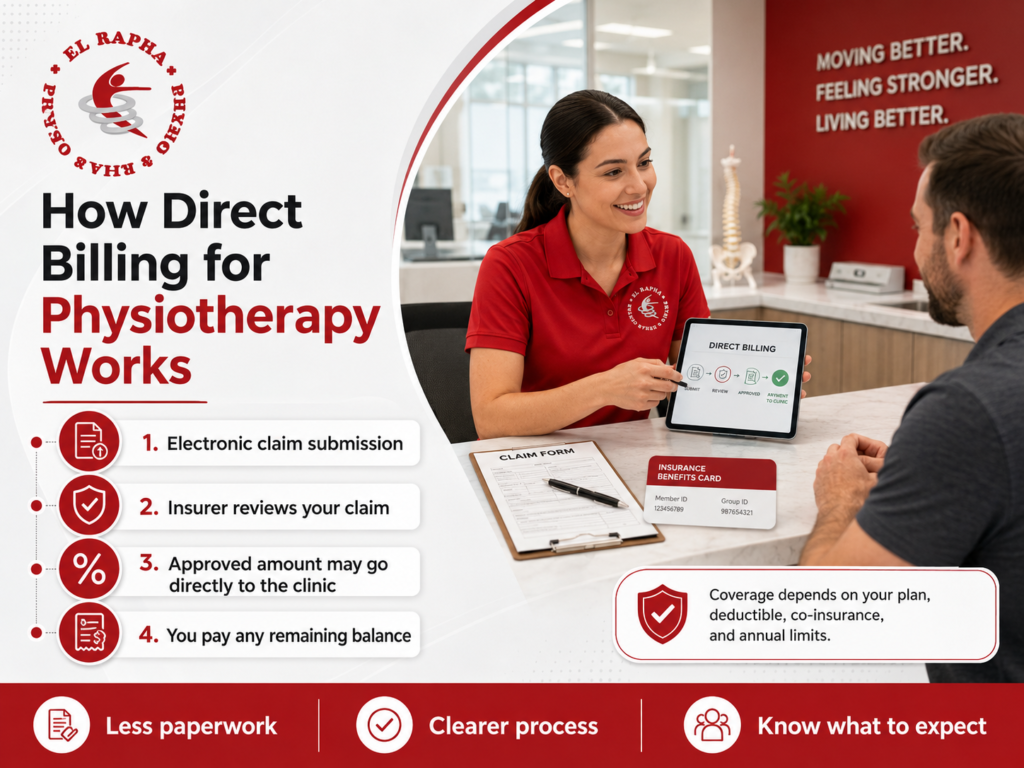
Direct billing is an electronic claims process connecting you, the physiotherapy provider, and your insurance company. After an eligible physiotherapy treatment has been provided, authorized clinic staff can enter the required patient, provider, treatment, and billing information into an insurer-supported electronic claims system. Your insurance company will then review the information according to your benefits contract and return a response indicating whether the claim has been approved, partially approved, held for review, or denied.
When payment assignment is permitted by your benefits plan, the insurer can also send the approved portion of the claim directly to the physiotherapy clinic, instead of reimbursing you for the treatment. This is what many patients mean when asking whether a physiotherapy clinic “direct bills.” According to TELUS Health, its eClaims service allows health-care professionals to submit insurance claims on behalf of their patients, potentially reducing the amount of money a patient is required to pay for treatment.
Consider a simplified example for a physiotherapy visit costing $100 and a patient’s plan reimburses 80% of eligible physiotherapy expenses. If the insurer approves the full $100 as an eligible expense allowing payment to the provider, approximately $80 may be paid through insurance while the patient pays the remaining $20. Actual reimbursement will depend on your individual policy, available benefits, any applicable deductible, the rules outlined by your insurer, and eligible fees for the physiotherapy service or product.
This distinction is important because direct billing and insurance coverage are not the same thing. Direct billing refers to how an eligible claim can be submitted to your insurance company while coverage describes what your benefits plan will actually reimburse. Physiotherapy clinics can successfully submit a direct-billing claim even when your insurer only approves a portion of the treatment.
Patients should also be familiar with common health insurance terminology. Your benefits plan may state that it will reimburse a percentage of the fee, up to a maximum amount per treatment or per year for physiotherapy, or for all paramedical services combined. Some plans also have a deductible, co-insurance, or a reasonable-and-customary fee limitation. Each of these considerations can impact your out-of-pocket expenses even when direct billing is an option.
What You Need to Bring for Physiotherapy Direct Billing
The most important item to bring for physiotherapy direct billing is your insurance benefits information. A physical insurance card is normally helpful, although many insurers now offer a digital benefits card through a mobile application or online portal. Sun Life, for example, asks patients whose providers submit claims directly to the insurer to show their coverage card.
Your insurance information normally includes the insurance company’s name, your policy or plan number, your certificate or member identification number, and the name of the policyholder. When you are covered under your spouse or parent’s plan, the clinic may also ask for your relationship to the policyholder. You should also ensure that your legal name and date of birth match the information on file with your insurer.
For dependants, the clinic may ask for additional information about the policyholder. If your child is receiving physiotherapy, for example, the reception staff may ask for your benefits information instead. When two separate insurance plans are available, such as coverage through both parents, additional information may be necessary before the claims can be coordinated.
Bring a physician’s referral if your insurance plan requires one or if you have already received a referral related to the condition being treated. Not every extended health plan requires a medical referral for physiotherapy. Requirements vary between insurance contracts, however. Canada Life’s online claim portal, for example, asks plan members a series of questions, including whether a doctor’s referral was required before physiotherapy services could begin.
It can also be helpful to bring any relevant medical documentation, imaging reports, surgical instructions, hospital discharge information, or specialist recommendations when clinically appropriate. While these items are normally associated with assessment and treatment planning, they can also be helpful for insurance-related queries. Your physiotherapist may need this information to understand the injury, any relevant precautions, the associated diagnosis, or the rehabilitation objectives.
Why Your Insurance May Not Pay the Entire Physiotherapy Fee
One of the most common misconceptions about direct billing occurs when patients expect their insurance company to reimburse the full physiotherapy fee. Extended health benefits can vary significantly between employers and individual plans. Two people with the same insurer can have vastly different physiotherapy benefits if their employers purchased different policies.
Your benefits plan may reimburse 80% or 90% of eligible expenses or it may state that it will pay up to a certain amount for each physiotherapy visit or for all paramedical services combined. Some extended health plans also have a yearly maximum for physiotherapy or for all paramedical services. Reasonable-and-customary limits also apply in some cases. Your physiotherapy clinic cannot independently determine how much your insurance company will reimburse.
Annual maximums are also important to consider. If your plan, for example, provides $750 of physiotherapy benefits per year, those funds will no longer be available for subsequent treatment following an approved claim. Patients who have undergone surgery, sports-related injury rehabilitation, chronic pain management, or motor vehicle collision physiotherapy should be particularly mindful of their remaining annual benefits.
Searching for physiotherapy etobicoke or physiotherapy Toronto services should therefore include more than asking whether a clinic “accepts insurance.” You should ideally ask whether the physiotherapy clinic can electronically bill your specific insurer and whether your benefits plan allows for direct payment to the provider.
A claim can also be denied or held for review even when you have physiotherapy coverage. Common administrative reasons include incorrect information, an inactive plan, an exhausted annual maximum, incorrect patient information, a service not covered by your benefits, or a request for additional documentation from your insurer. A direct billing claim being rejected therefore does not necessarily mean that physiotherapy is not medically necessary.
How to Prepare Before Your First Physiotherapy Appointment
Before your first physiotherapy appointment, contact your insurance company or review your benefits portal. Ask whether physiotherapy is covered, the percentage of reimbursement, the annual maximum, remaining balance, deductible, per-visit limitation, and whether a doctor’s referral is required. You can also ask whether your plan allows for direct payment to the physiotherapy provider.
Patients sometimes ask reception staff to advise them about how much insurance coverage they have. Clinics can normally submit a direct billing claim and may be able to provide information about the current claim, but they do not always have access to your benefits contract or remaining annual balance. Your insurance company or online benefits portal should be able to provide more information about your eligibility, limitations, and remaining annual benefits.
If you have two insurance plans, let the clinic know before your physiotherapy treatment begins. Eligible expenses not covered by your primary plan may sometimes be submitted to your secondary insurer, depending on the coordination of benefits. The procedure will normally depend on who holds each plan and the rules described by your insurers. Having two insurance policies does not necessarily mean that both will reimburse physiotherapy expenses.
Patients should also consider retaining copies of all receipts and insurance-related documentation. Even when direct billing is available, organized records can be helpful for reviewing annual benefits, coordinating secondary insurance, disputing a denied claim, or completing income-tax documentation when applicable.
Insurance administration should ideally be a convenience for patients seeking physiotherapy services. Your physiotherapist’s primary responsibility should be focused on assessing your movement, function, pain, strength, mobility, and relevant neurological or musculoskeletal findings when applicable. Insurance coverage limitations will determine reimbursement, but they should not dictate your physiotherapy treatment plan.
Conclusion
Direct billing can make physiotherapy considerably more convenient by reducing administrative work and, in some cases, the amount of money you are required to pay for treatment. Electronic claims systems have been adopted by insurers and physiotherapy clinics, allowing many direct billing claims to be submitted immediately following an eligible treatment.
With that said, direct billing should not be confused with unlimited or automatic coverage by insurance. The amount of your physiotherapy claim that will be approved depends on your benefits contract, reimbursement percentage, annual maximum, deductible, eligibility requirements, provider agreements, and remaining annual balance. Physiotherapy services are also not automatically covered by OHIP or other provincial health-insurance plans. Many Ontario residents have private or employer-sponsored physiotherapy benefits or are required to pay for services out-of-pocket.
For the most seamless first appointment, bring your insurance card or digital benefits information, verify your policy details beforehand, provide a referral when required by your plan, and advise the clinic about secondary insurance coverage. A few minutes spent reviewing your benefits can prevent delays and ensure that your physiotherapy appointment can focus on your rehabilitation.
Frequently Asked Questions About Physiotherapy Direct Billing
1. What does direct billing for physiotherapy mean?
Direct billing means the physiotherapy clinic can electronically submit an eligible treatment claim to your insurance company on your behalf. Depending on your benefits plan, the insurer can reimburse the approved portion of the fee directly to the physiotherapy clinic.
2. Does direct billing mean I do not have to pay anything?
No. Your insurance may only cover a portion of the physiotherapy fee. You may be responsible for a co-insurance, deductible, amount exceeding the eligible fee, or the full fee if your annual benefits have been exhausted.
3. What insurance information should I bring?
You should bring your insurance card or digital benefits information. Ideally, you should also have your insurer’s name, policy or plan number, certificate or member number, the policyholder’s name, and your relationship to the policyholder if you are a dependant.
4. Do I need a doctor’s referral for physiotherapy insurance?
It depends on your benefits contract. Some plans do not require a physician’s referral for physiotherapy while others may require one before any expenses can be submitted for reimbursement. Contact your insurance company to confirm before beginning treatment.
5. Can a physiotherapy clinic check how much coverage I have?
Sometimes, when a direct-billing system is available, a physiotherapy clinic can provide information about your most recent claim. Clinics, however, do not always have access to your full benefits contract or remaining annual balance. Your insurance company or benefits portal should be able to provide more information about your eligibility, limitations, and remaining benefits.
6. What happens when insurance pays only part of my treatment?
The insurer may reimburse the physiotherapy clinic for the eligible portion of the fee while you are responsible for the patient portion of the claim. For example, you may be responsible for the balance if an eligible $100 treatment is reimbursed at 80%, the patient may be responsible for the remaining $20, subject to the terms of your benefits plan.
7. Why would a direct-billing claim be rejected?
A direct-billing claim can be rejected for various reasons, including incorrect member information, inactive coverage, an exhausted annual maximum, a requirement for a physician’s referral, eligibility requirements, provider-registration issues, or a request for additional information by the insurer. Contact your insurance company to determine the exact reason for the rejection.
8. Can I use two insurance plans for physiotherapy?
It depends on your benefits plan. If you have primary and secondary health coverage, eligible expenses not covered by your primary insurer may sometimes be submitted to your secondary insurer, depending on the coordination of benefits. The procedure will normally depend on who holds each plan and the rules described by your insurers.
9. Is physiotherapy automatically covered by OHIP in Ontario?
No. Physiotherapy is not automatically covered by OHIP. Physiotherapy services are normally provided by private clinics and may be covered by your extended health benefits or paid for out-of-pocket.
10. What should I ask my insurance company before booking physiotherapy?
Ask whether physiotherapy is covered, the percentage of reimbursement, your annual maximum and remaining balance, whether there is a per-visit limit or deductible, whether a doctor’s referral is required, and whether your policy allows direct payment to the physiotherapy provider.